Why Algae and Mold Come Back Faster in Some Central Florida Neighborhoods
Field notes on regrowth speed across the 23 cities we serve in Volusia, Seminole, and Orange counties, plus a practical cleaning-frequency guide by surface and condition.
By Clark Sabo, Owner of Classic Pressure Washing | Last updated September 12, 2026
After years of cleaning driveways, roofs, siding, and pool cagesacross Central Florida, our crews keep seeing the same pattern repeat: how fast algae and mold come back after a cleaning depends less on the calendar and more on four conditions at your specific property. Florida’s combination of heat and humidity creates year-round conditions for mold and algae growth that drier climates simply do not see, per the EPA’s guidance on mold growth conditions, and NOAA tracks Central Florida as one of the most humid regions in the continental United States. This guide pulls together what we have documented city by city across the 23 communities we serve in Volusia, Seminole, and Orange counties, and turns it into a practical cleaning-frequency guide.
A note on what this is: this is a synthesis of field observations from our own crews, not a scientific study. We are not measuring spore counts or running controlled trials. The ranges below come from what we see when we return to properties across these neighborhoods year after year. Treat them as planning guidance, not guarantees.
The Four Factors That Drive Regrowth Speed
These are not independent. Properties that stack two or more of them are the ones that come back dirty first.
Tree Canopy & Shade
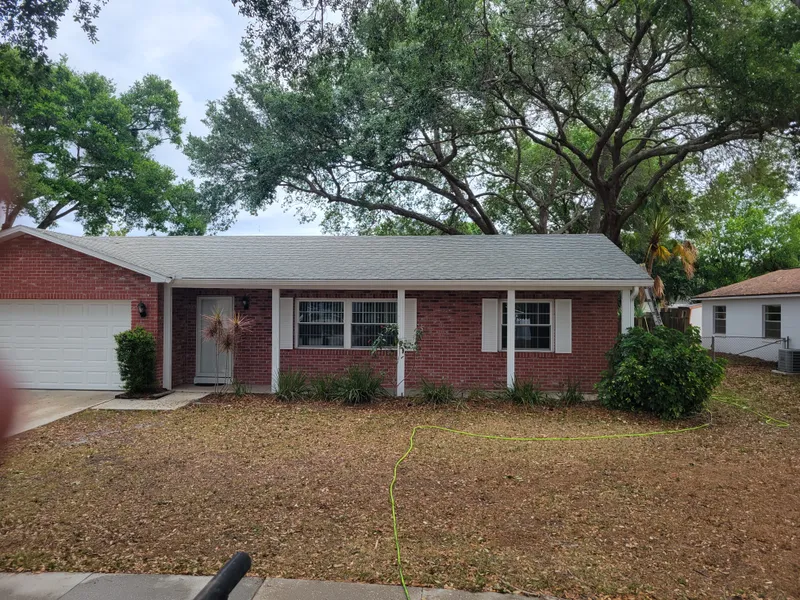
Heavy oak and hardwood canopy is the biggest accelerant we see. It keeps roofs, driveways, and walls shaded and damp long after everywhere else has dried out. Longwood's Wekiva-basin neighborhoods sit against conservation-land oak hammock that drops leaves, pollen, and tannic acid onto every surface, and the older homes in its Historic District develop deep-set mold noticeably faster than the newer builds nearby. Casselberry's Deer Run and Lake Howell areas, Oviedo's Twin Rivers and Alafaya Woods, and the oak canopy around Orange City's Blue Spring State Park corridor all show the same thing: shade plus moisture is exactly what Gloeocapsa magma, the bacteria behind black roof streaks, and green algae need to re-establish. See our full breakdown of what those black streaks actually are and why pressure washing alone makes them worse.
Water Proximity & Humidity
Standing or moving water nearby raises ambient humidity even on dry days. Daytona Beach's combination of beachside salt air and mainland humidity produces some of the fastest mold and algae growth we see anywhere in the county. New Smyrna Beach goes a step further: between oceanfront salt spray, canal-front homes, and tidal-flat moisture inland near the Sugar Mill Ruins, roof algae develops faster there than almost anywhere else we work. Inland lake chains carry the same effect without the salt: Casselberry's cluster of small lakes, Winter Park's chain of lakes, and Deltona's interconnected lake system with its high water table all keep humidity elevated at ground level, while DeBary's St. Johns River fog keeps surfaces damp well past sunrise.
Construction Era & Surface Porosity
Older concrete block from the 1960s and 70s, common in Deltona, Holly Hill, South Daytona, and parts of Orange City, has more surface porosity than modern stucco. Deltona's thousands of original block homes on low, lake-adjacent lots develop heavy black staining within about 12 months of a cleaning, the fastest documented regrowth window we track anywhere. Maitland's 1950s and 60s homes have textured block and exposed-aggregate surfaces that trap algae down in the pores, which is why they need a thorough low-pressure soft wash rather than a quick rinse. On the flip side, newer stucco in fast-growing areas like Winter Garden's Hamlin and Horizon West communities is lighter in color, so dirt, tire marks, and early-stage algae show up visually much sooner, even when the underlying growth rate is not necessarily faster.
Sun Exposure & Orientation
Two of our local notes call this out directly. Orange City properties near Minnesota Avenue show the worst algae specifically on north-facing walls, and South Daytona's Reed Canal and Big Tree Park homes see the same thing on north-facing block walls, worsened by poor lot drainage. North-facing surfaces get little to no direct sun to dry them out after rain or morning dew, so any of the other three factors compound faster once they are paired with a north-facing wall or roof plane.
Fastest-regrowth combinations
These are the cities where two or more of the four factors stack, and where our own notes already use language like “fastest” or a specific timeframe.
- Deltona: old block construction plus a high water table and interconnected lakes. Heavy black staining in roughly 12 months, the fastest documented turnaround we track.
- New Smyrna Beach: coastal salt, canal frontage, and tidal-flat moisture. Roof algae develops faster here than almost anywhere else we work.
- Daytona Beach: beachside salt film plus mainland humidity. Some of the fastest mold and algae growth we see countywide.
- Ormond Beach: the same coastal salt exposure as Daytona beachside, compounded by 1970s-80s construction in Ormond by the Sea.
- Casselberry: a lake-chain city with mature tree canopy over 1970s-80s block and driveways.
- Holly Hill: 1960s block on tightly spaced, shaded lots between Daytona and Ormond.
- South Daytona: low, poorly drained lots with dense tree cover and north-facing block walls.
- Longwood (Historic District / Wekiva basin): river-basin shade and persistent moisture over older construction.
Slower-regrowth conditions
Florida's climate makes some regrowth inevitable everywhere we work, so we have fewer notes on what slows it down than on what speeds it up. These are the properties that dodge two or more of the four factors above, and they hold their clean look the longest as a result.
- Winter Garden (Hamlin / Horizon West): newer construction without the mature, shade-heavy landscaping older subdivisions have built up. The lighter stucco shows dirt sooner even though the underlying growth is not necessarily faster.
- Lake Mary (Heathrow / Timacuan): large estate lots away from lake chains and coastline, though the strictest HOA architectural review in our service area means these homeowners often clean on a fixed schedule regardless of natural growth speed.
- Altamonte Springs: dense condo and townhome development where irrigation overspray on smaller lots is the main driver, not canopy or waterfront exposure.
“Slower” is relative. Every property in our service area still needs regular cleaning; these ones can just go longer between visits.
Cleaning-Frequency Guide by Surface & Condition
Pulled from what we tell customers on every service we run. “Accelerated” means any property with one or more of the four factors above. Sealing a driveway after cleaning can stretch that standard interval further.
| Surface | Standard exposure | Heavy shade / water / north-facing |
|---|---|---|
| Roof, soft-washed | 2 to 3 years | Under heavy tree canopy or on north-facing roof planes, regrowth shows up well before the 2-year mark |
| Roof, surface-rinse only (no soft wash) | Regrowth 2 to 3x faster than a soft-washed roof | Same multiplier applies, compounded further by shade or coastal salt |
| House exterior, soft-washed (stucco, siding, painted surfaces) | 10 to 18 months | 8 to 10 months under heavy tree cover or on north-facing walls |
| House exterior, rinse only (no surfactant) | 4 to 6 months | Shorter still when combined with shade or water proximity |
| Driveways & concrete | 12 to 18 months | Annually under heavy shade, near a retention pond, or with regular fertilizer runoff |
| Pool cage / screen enclosure | Annually | 8 to 10 months under heavy tree cover, near a retention pond, or on the north side of the property |
| Vinyl fencing | Annually | 8 to 10 months in shaded areas or near retention ponds |
| Wood / composite decking | Annually (minimum) | 8 to 10 months under tree canopy or on the north side of the house |
Where All 23 Cities We Serve Fall
Grouped by how many of the four factors stack in each city, not restated one by one.
Fastest regrowth
- Deltona: old block construction over an interconnected lake system; heaviest staining we see, typically within about a year
- New Smyrna Beach: coastal salt, canal frontage, and tidal-flat moisture inland
- Daytona Beach: beachside salt film plus mainland humidity
- Ormond Beach: coastal salt exposure like Daytona beachside, plus 1970s-80s construction
- Casselberry: lake-chain humidity over mature tree canopy
- Holly Hill: 1960s block on tightly spaced, shaded lots
- South Daytona: poor drainage, dense tree cover, and north-facing block walls
- Longwood: Wekiva-basin shade over older Historic District construction
- Maitland: overhanging landscaping over porous 1950s-60s block and exposed aggregate
- Orange City: oak canopy and spring-fed humidity, worst on north-facing walls
Moderate, one dominant factor
- Port Orange: mature landscaping trapping moisture against stucco on large lots
- DeBary: St. Johns River fog and morning dew
- DeLand: newer stucco and barrel tile can show streaks within about a year
- Sanford: Lake Monroe waterfront humidity meets a historic downtown
- Oviedo: heavy oak canopy over 1990s stucco subdivisions
- Winter Springs: mature oaks and palms dropping organic debris year-round
- Orlando: dense canopy in older neighborhoods, standard care in newer suburbs
- Winter Park: lakefront humidity and century-old oaks over high-value finishes
- Apopka: vegetation buffers bring heavy pollen deposits, a different mechanism than standard algae
- Ocoee: lakefront communities where fertilizer runoff feeds algae
Fewer compounding factors
- Winter Garden: newer, lighter stucco in Hamlin and Horizon West shows buildup sooner visually, without the compounding shade or water factors seen elsewhere
- Lake Mary: large lots away from lake chains and coastline, though strict HOA review drives cleaning on a fixed schedule
- Altamonte Springs: irrigation overspray on smaller lots is the main driver, not canopy or waterfront
Frequently Asked Questions
Does tree canopy really make algae and mold come back faster?
Why does a brand-new house in Winter Garden already have algae stains?
What is the fastest-regrowth combination you see in Central Florida?
Not sure where your property falls?
We'll look at your canopy, drainage, construction, and orientation on-site and give you a real cleaning schedule, not a generic one.